


Laser, waterjet and plasma each cut metal, and each is the wrong choice for some parts. Laser gives clean accurate profiles, waterjet cuts cold with no heat-affected zone, and plasma is fastest and cheapest on heavy plate. The honest answer depends on your material, thickness and what the cut edge has to survive.
| Laser | Waterjet | CNC plasma | |
|---|---|---|---|
| Cuts with | Focused light and heat | Water and abrasive | Ionised gas and heat |
| Heat into the part | Yes, localised | None | Yes, more than laser |
| Edge quality | Excellent | Very good | Adequate, usually welded anyway |
| Accuracy | Highest | High | Lower |
| Kerf width | Narrowest | Narrow | Widest |
| Speed on thin material | Fastest | Slowest | Fast |
| Cost on heavy plate | High | Highest | Lowest |
| Best at | Intricate profiles, tight hole spacing | Anything that must not be heated | Structural plate, volume |
Ask a shop that owns one cutting machine which process suits your part, and you can usually predict the answer.
We run laser, waterjet and CNC plasma. That does not make us more virtuous, but it does mean we have no reason to talk you into the wrong one. Here is how the three actually compare.
At HPS all three run in carbon steel, stainless steel, aluminum and alloys, within an overall range of 16 gauge to 2.5 inches, the top end being our plasma table.
Laser cutting
A laser edge usually needs little or no secondary work, which quietly removes a deburring step from your job, and holes land accurately relative to each other, which matters when the part has to bolt to something made by somebody else.
The limit is heat. On thin material that is irrelevant; on thicker material, or on alloys whose properties depend on heat treatment, the localised heat-affected zone can matter. Very reflective materials and very heavy plate suit the alternatives better.
More on laser cutting.
Waterjet cutting
Waterjet cuts cold, with water and grit rather than heat, so nothing about the metal changes at the cut edge: no hardening, no tempering, no discolouration, no thermal distortion.
Where it wins. Three situations specifically:
- The cut edge will be highly stressed in service. A heat-affected zone is a preferred starting point for a fatigue crack.
- The material is an alloy whose properties depend on its heat treatment, which a thermal cut would locally undo.
- The part is thin and would distort if heated, or must stay flat.
Nobody should specify waterjet by default. It earns its cost when the alternative is a heat-treatment step afterwards, a scrapped part, or a weld that fails in service. On a safety-critical assembly, where a cut edge will be highly stressed for the life of the part, “the cut edge is metallurgically unchanged” is worth paying for without much debate.
More on waterjet cutting.
CNC plasma cutting
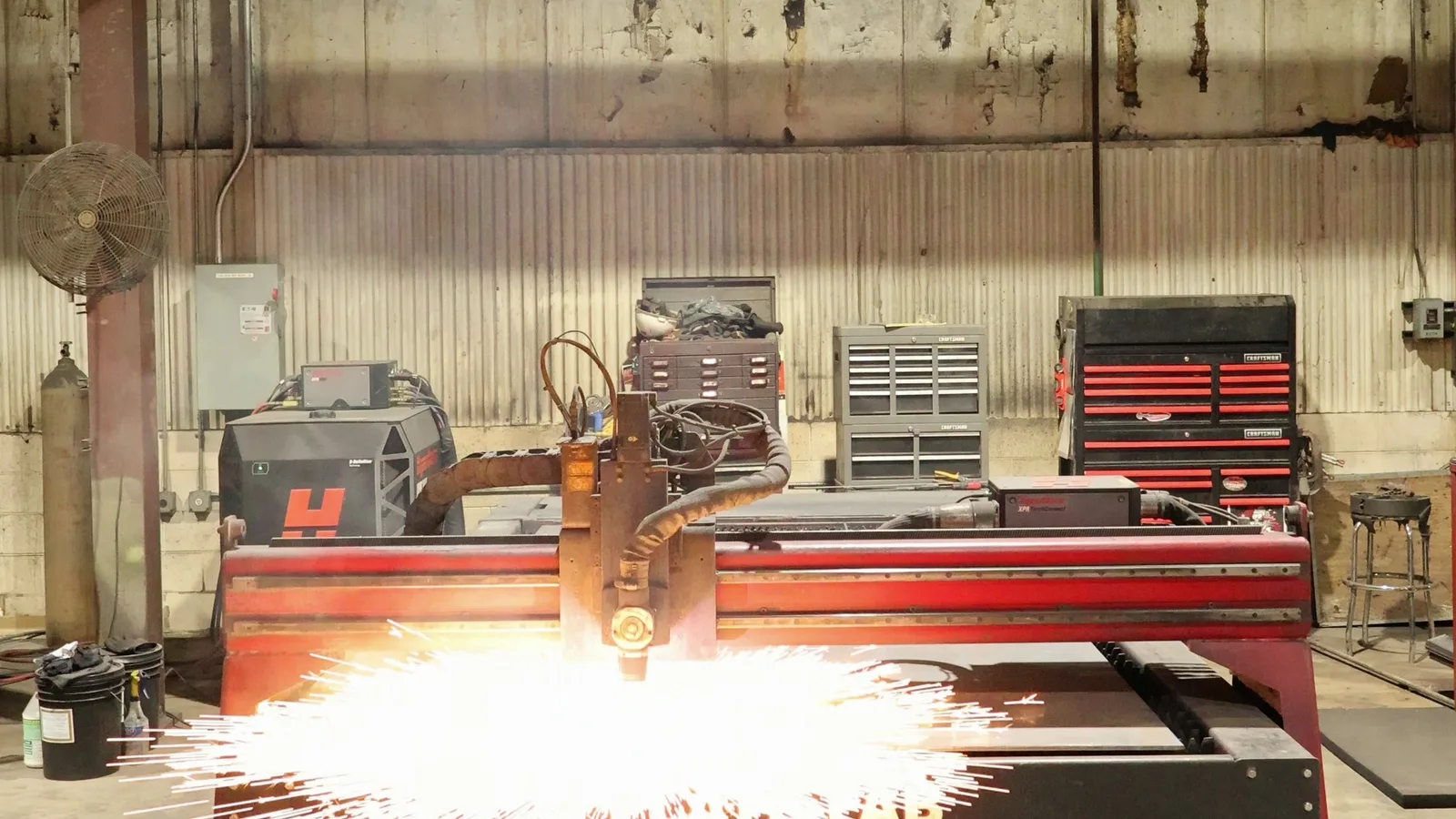
Plasma gets through plate quickly and economically, and for most structural parts its edge quality is more than sufficient, particularly when the edge is about to be welded, which consumes it anyway. We cut on a Koike Aronson Plate-Fab table and nest parts to get the most out of each plate, which shows up in the job price rather than as a line item.
If the profile is intricate, or holes must be precisely located relative to each other, use laser instead.
More on CNC plasma cutting.
How to actually choose
Work through it in this order.
1. Can the part tolerate heat at the cut edge? If no, because of stress, alloy heat treatment, or distortion: the answer is waterjet, and the rest of the questions do not matter.
2. How thick is it? Thin sheet favours laser. Heavy plate favours plasma. In between, it depends on question 3.
3. What does the edge have to do next? Getting welded? Plasma is fine. Being a bearing or sealing surface, or visible on a finished product? Laser or waterjet.
4. How accurate does it have to be? Tight hole-to-hole relationships push you to laser.
5. How many are you making? At volume, small differences in cost per part dominate. At quantity one, setup and speed matter more.
The question behind the question
Buyers usually ask which process to use. The more useful question is usually what happens to the part after it is cut.
Cutting is the first operation, not the job. Most parts that leave our shop have also been formed on a press brake, welded into an assembly on our own fixture tables, machined, and coated in our own paint booth, without leaving the company.
If you are pricing cutting from three different suppliers and then arranging forming, welding and coating separately, you are managing four schedules and four interpretations of one drawing. That coordination is real work, and it usually costs more than the difference between the cutting quotes.
Every time a project changes hands, risk goes up.
When the part does not exist yet
Sometimes the honest answer to “which cutting process?” is that the part needs designing first.
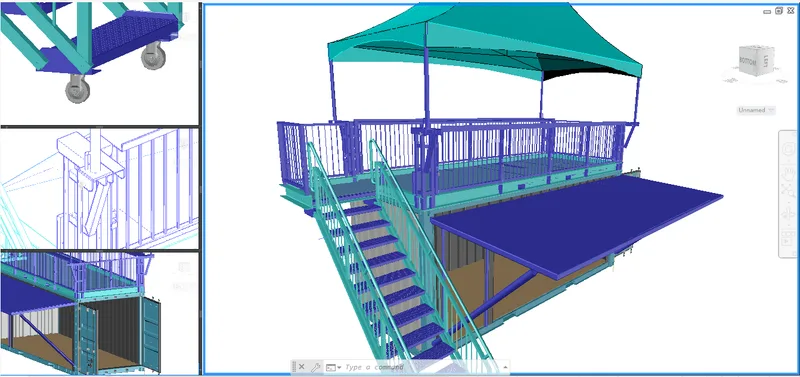
If you know what the equipment has to do but not yet what it looks like, that is design-build, our licensed professional engineers model and analyse the assembly, and the process selection falls out of the design rather than being decided before it.
What to send us
A DXF or STEP file quotes fastest. DWG, IGES and PDF all work.
Tell us the material, the thickness, the quantity, and the part people leave out, what the part has to survive in service. That last one changes the process recommendation more often than anything else on the drawing.
Not sure which process you need? That is fine, it is our job to know.
Common questions
Laser vs Waterjet vs Plasma: questions buyers ask
Which process is cheapest?
It depends entirely on the part. On thin material laser is usually fastest and therefore cheapest; on heavy plate CNC plasma usually wins; waterjet is rarely the cheapest and is chosen when the part cannot tolerate heat. Any shop that answers this question without asking about your material and thickness owns one machine.
Can you cut my material?
Carbon steel, stainless steel, aluminum and alloys, from 16 gauge up to 2.5 inches, the top end being our plasma table.
What if I pick the wrong process?
Tell us what the part has to do and we will tell you. We run all three machines, so we have no commercial reason to steer you onto the wrong one.
Do you quote from a drawing or can I just describe the part?
Either. DXF, DWG, STEP, IGES and PDF all work. If you have no drawing, describe the part and our engineers will work from that.