
Capability
Design-Build Engineering
HPS Fabrications designs the part as well as builds it. Licensed professional engineers work in the same building as the fabricators who cut and weld, so a customer can arrive with a goal instead of a drawing. If you know what the equipment has to do but not yet what it looks like, we can quote that.
- 1985ENCO engineering divisionPort and shiploader engineering added 1990
- Licensed PEsOn staff, not subcontractedMechanical, electrical and structural
- 16 ga to 2 inCutting range in houseCarbon steel, stainless, aluminum, alloys
| Engineering disciplines | Mechanical, electrical, structural |
|---|---|
| Licensure | Licensed professional engineers on staff |
| Design services | CAD modeling, simulation, finite element analysis, system optimization |
| Lifecycle | Concept, design, fabrication, assembly, installation, field support |
| Engineering division | ENCO Engineering, in house since 1985 |
| Materials | Carbon steel, stainless, aluminum, alloys |
| Cutting range | 16 gauge to 2.5 inches; heavier sections built up from plate |
Build to print, or design build
The distinction decides how much of the risk is yours.
Tom D’Angelo, who owns HPS, puts it plainly: “Build to print is when a customer has a design already in place and gives you a set of prints. On the design-build side, you’re given a concept of what the customer is trying to achieve, and you give them an engineered solution to meet that goal.”
Most fabricators only do the first. We do both: when a print exists we build to it, and when one does not, our engineers produce it alongside the people who will cut and weld the part.
What “engineering in house” actually means
Licensed professional engineers, employed by us, in mechanical, electrical and structural disciplines. Designing for a specific situation, including wind loads and structural weights and loads, happens here rather than at a firm we hire.
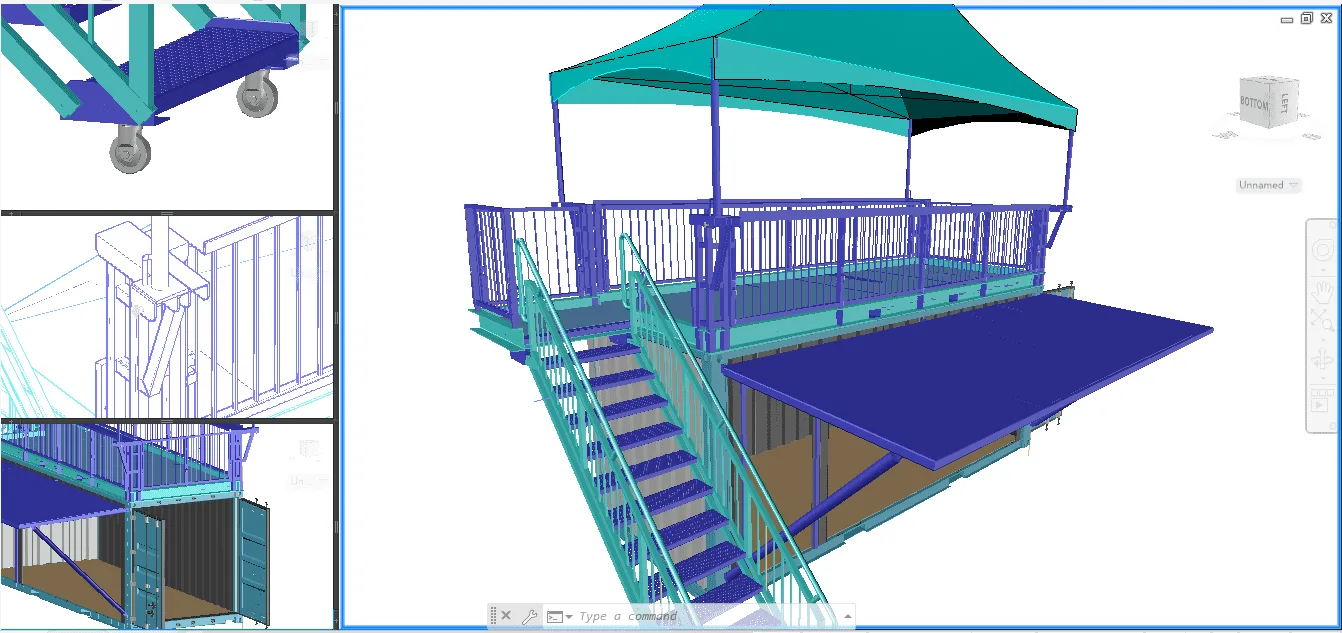
- CAD modeling of the assembly before any steel is cut
- Simulation and finite element analysis: so loads are understood rather than assumed
- System optimization: reducing part count, weight or process steps
- Prototyping and first-article work
- Field support during installation and commissioning
ENCO Engineering has been our in-house engineering division since 1985, and added port and shiploader engineering in 1990, which is why a Michigan fabricator engineers equipment for ports abroad.
Every handoff is a place for the job to go wrong
A typical fabricated assembly passes through an engineering firm, a cutting house, a weld shop, a machine shop and a coater. Five companies, five schedules, five readings of the same drawing, and nobody who owns the outcome. Here it is one organization from concept to installed equipment.
Every time a project changes hands, risk goes up.
That pressure is not imagined, either. Engineering headcount left a great many OEMs and never came back, so design work that used to happen at the customer has moved down the supply chain. If your fabricator cannot absorb it, you are absorbing it yourself.
The work this suits
- You know the performance requirement but not the design: a load to carry, a rate to move, an envelope to fit inside
- The equipment is safety-critical and needs analysis rather than assumption
- An existing design isn’t working and needs re-engineering rather than rebuilding
- You want one supplier accountable instead of coordinating five
The clearest example runs over thirty years: HPS has built hundreds of molten salt bath systems, each engineered around a customer’s own process rather than picked from a catalogue, up to a continuous unit 100 feet long and 20 feet on each side. The Navy submarine ventilation hatch houses show the other shape of the same thing, redesigned from a stopgap product through successive engineering changes.
What to send us
You do not need finished drawings to get a quote. Useful, in rough order:
- What the equipment has to do: the load, the rate, the duty cycle, the environment
- Where it has to fit: envelope, access, existing structure it ties into
- Any standards it has to meet
- Whatever you already have: a sketch, a photo of the thing it replaces, a marked-up print, a STEP file
Have a full drawing package? Send it and we will quote build-to-print instead.
| Engineering firm plus a shop | Design-build at HPS | |
|---|---|---|
| Who you contract with | Two companies, two schedules | One company, concept to installed equipment |
| Who checks buildability | Nobody, until the shop quotes it | The fabricators, while it is still a drawing |
| If the design needs changing | A change order with the design firm | A conversation down the hall |
| If it does not fit on site | The two suppliers disagree | One party is accountable |
Common questions
Design-Build Engineering: questions buyers ask
I do not have drawings. Can you still quote?
Yes. Tell us the load, the rate, the envelope and the environment, and that is enough to start. Licensed professional engineers are on staff in mechanical, electrical and structural disciplines, and the design work is part of the job rather than something you have to buy separately first.
Do you actually employ engineers, or subcontract it?
On staff. ENCO Engineering has been the in-house engineering division since 1985 and added port and shiploader engineering in 1990. Nothing about the design work is subcontracted.
What does the engineering actually cover?
CAD modelling, simulation, finite element analysis, prototyping, system optimisation and field support. In Tom D'Angelo's words: we are not only able to build product, we are able to design product for specific situations, including wind loads and structural weights and loads.
Why not use a separate engineering firm and a separate shop?
You can, and plenty of buyers do. The cost shows up at the handover. Every time a project changes hands, risk goes up: the firm that drew it is not the shop that has to build it, and when the two disagree you are the one in the middle. Here the engineers and the fabricators are in the same building.
Will you tell me if the design is wrong?
Yes, before steel is cut rather than at assembly. That is the whole value of reviewing the design in the shop that has to make it.